

Guide · Supervisor
Sound practices for managing intraday liquidity risk
The ECB distinguishes between fundamental practices and aspirational practices for managing liquidity within the day.
- Organization
- ECB Banking Supervision
- Document date
- November 2024
- Type
- Guide
- Language
- English
- Scope
- Euro area
- Length
- 13 pages
What it contains
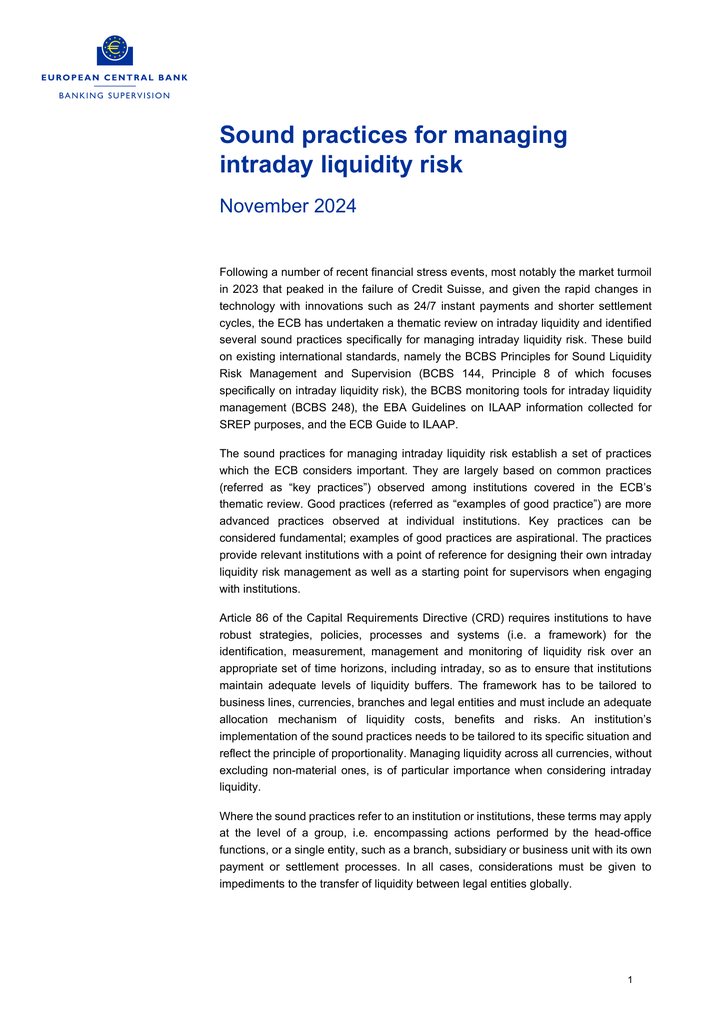
After the 2023 stress episodes, which culminated in the failure of Credit Suisse, and with innovations such as 24/7 instant payments and shorter settlement cycles, the ECB carried out a thematic review of intraday liquidity and identified specific practices. They build on international standards: the Basel Principles for Sound Liquidity Risk Management and Supervision (principle 8 addresses intraday liquidity), the Basel monitoring tools for intraday liquidity management, the EBA guidelines on ILAAP information and the ECB Guide to ILAAP.
The practices are grouped into seven principles: risk management framework, governance, forecasting, monitoring, management of outflows, sources of liquidity and stress testing. Each one distinguishes between key practices, commonly observed in the institutions reviewed and considered fundamental, and examples of good practice, more advanced and observed in individual institutions, which are aspirational. The framework calls, for example, for clearly defining intraday liquidity risk and distinguishing it from the end-of-day concept, defining and regularly reviewing material sources of risk, formalising policies with roles and responsibilities, measuring the risk within risk appetite with review by the second line of defence, and having alerts, early warning indicators and sufficient staff across the three lines of defence.
The document recalls that Article 86 of the Capital Requirements Directive (CRD) requires robust strategies, policies, processes and systems to identify, measure, manage and monitor liquidity risk over horizons that include intraday, and that implementation must be tailored to each situation under the principle of proportionality. It places particular emphasis on managing liquidity in all currencies, including non-material ones.
Why it matters for risk management
It is a useful checklist for institutions with operations in real-time payment systems or with positions in several currencies. It is written for banks supervised by the ECB and rests on European regulation; its adaptation to other jurisdictions should follow criteria of proportionality.
Summary prepared by the Dominican Republic Risk Management Club from a reading of the original document, with the source verified on 7 October 2026. It does not replace reading the official text and is not advice.









Connect with our networks