

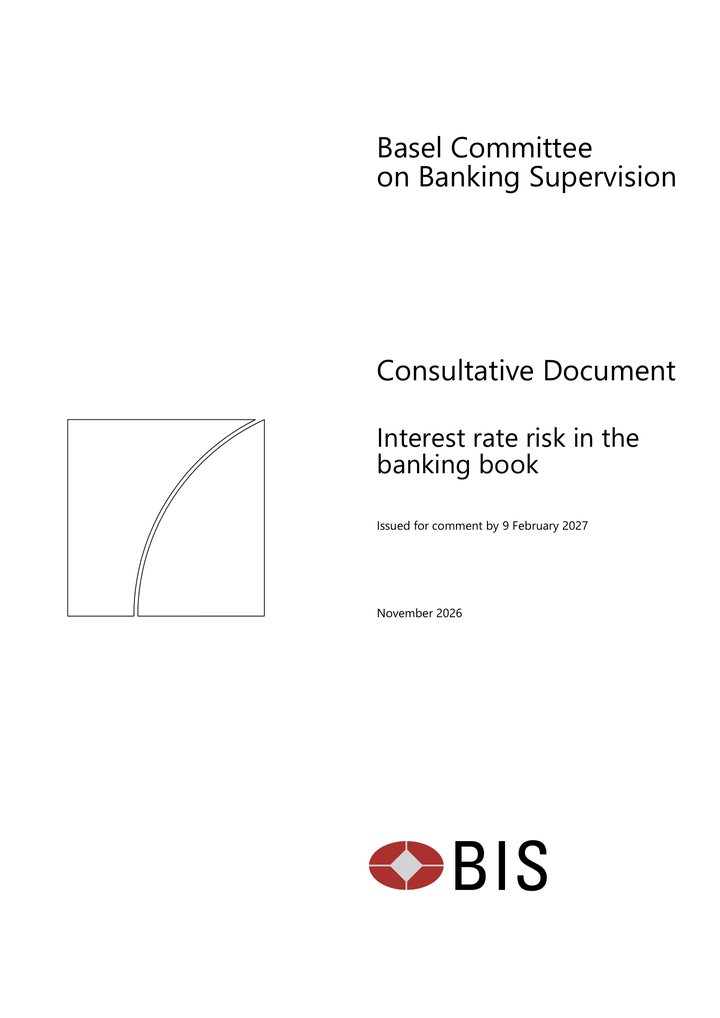
Public consultation · International body
Interest rate risk in the banking book: additional Pillar 2 guidance
After the inflation surge and the rise in rates, Basel proposes more demanding guidance on models, stress testing, embedded losses and earnings indicators, and a framework to compare peer banks.
- Organization
- Basel Committee on Banking Supervision (BCBS)
- Document date
- 9 November 2026
- Type
- Public consultation
- Language
- English
- Scope
- International
- Length
- 57 páginas
What it contains
On 9 November 2026 the Basel Committee on Banking Supervision published, as a consultative document, a proposal for additional Pillar 2 guidance on interest rate risk in the banking book (IRRBB). It starts from the Committee’s finding, in its analytical work of recent years, of shortcomings in banks’ fundamental management of certain basic banking risks, including IRRBB, which was tested by the acceleration of inflation, the sharp rise in rates and heightened volatility. The proposal creates standalone guidelines that complement the current framework and replace the application guidance in chapter SRP98 of the Basel Framework, amends chapter SRP31 and plans to move the content of SRP98 into section MIR20 of the consolidated guidelines, subject to a separate consultation on consequential amendments.
For banks, the proposal sets out practices in five areas: model risk governance and management, with validation and performance monitoring of models through backtesting of forecasts for non-maturity deposits, mortgage prepayment speed and deposit pricing, as well as key assumptions, time series and third-party vendor data; stress testing with several levels of rate shocks and non-parallel curves, revealing reliance on certain deposit segments and the non-linear effect of rate changes; IRRBB controls, including limits and authorised hedges; the treatment of embedded losses in securities held at amortised cost, with their effect on the economic value of equity (EVE) and capital headroom; and short- and medium-term earnings indicators, such as net interest income (NII) sensitivity, which complement the supervisory outlier test because, given its long horizon, it can conceal effects on earnings.
For supervisors, it introduces a peer comparison framework, with reference groups defined by static, operational or idiosyncratic dimensions, to identify earlier the banks with potentially excessive exposure and to apply tools such as supervisory backtesting of deposit models. It also creates “Supervisory Information”: data that banks would report on modelling practices, stress testing, hedging, earnings indicators and embedded losses, in order to close data gaps, improve the transparency of internal reporting and strengthen independent validation. Comments are received until 9 February 2027. The 57-page document includes in its annex the proposed edits to chapters SRP31 and SRP98.
Why it matters for risk management
It is a reference for reviewing how non-maturity deposits, prepayments and rate pass-through are modelled and validated, how the balance sheet is stressed and how much embedded losses in investment portfolios weigh on capital. For market risk, asset and liability management and model validation teams it offers a list of topics for self-assessing practices and preparing comments. It is a consultative document addressed to the jurisdictions that are members of the Basel Committee: it is not a rule and does not bind the Superintendency of Banks or the Central Bank of the Dominican Republic, and its text may change in the final version.
This summary describes the public consultation version (comments are received until 9 February 2027). The text may change in the final document; the summary will be updated when it is published.
Resumen elaborado por el Club de Gestión de Riesgos de la República Dominicana a partir de la lectura del documento original, con fuente verificada el 10 de noviembre de 2026. No sustituye la lectura del texto oficial ni constituye asesoría.



Connect with our networks