

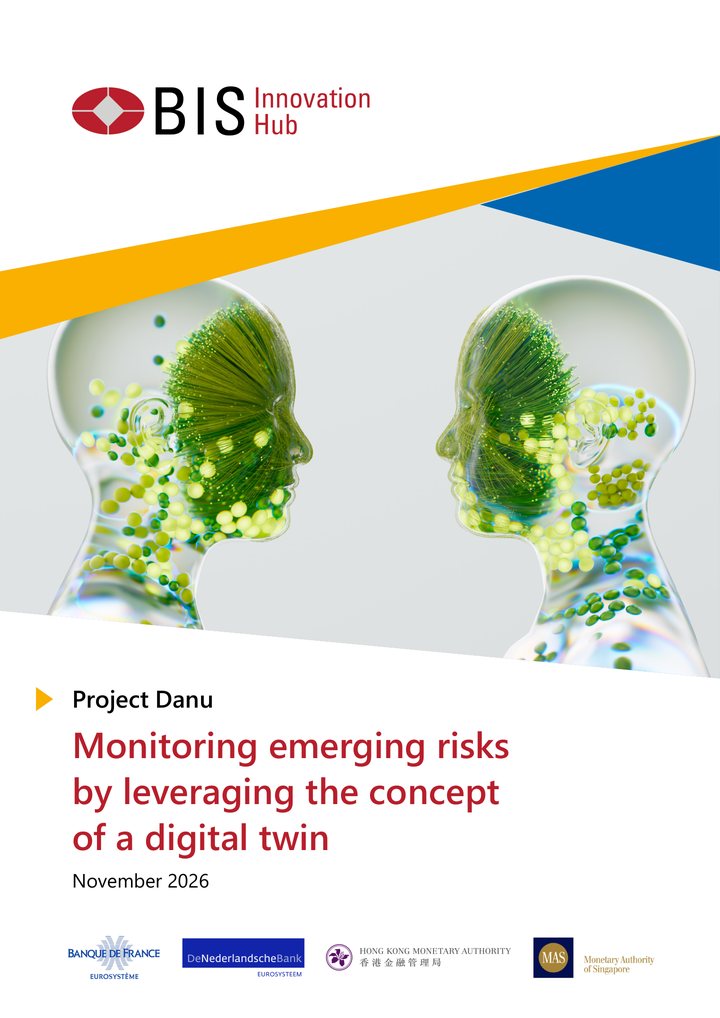
Report · International body
Project Danu: monitoring emerging risks by leveraging the concept of a digital twin
The BIS shows with an open-source prototype that globally available environmental data are enough to estimate, almost in real time, which assets are affected by a climate event and what the damage costs, even without institutions’ financial data.
- Organization
- Banco de Pagos Internacionales (BIS Innovation Hub)
- Document date
- 24 November 2026
- Type
- Report
- Language
- English
- Scope
- International
- Length
- 25 pages
What it contains
The Project Danu report, from the BIS Innovation Hub and published on 24 November 2026, explores how to make the digital twin concept, a virtual representation of a real-world system, practical, scalable and reusable for central banks and supervisors when applied to the analysis of physical climate risks. It builds on a proof of concept by the Bank of France, De Nederlandsche Bank and the Hong Kong Monetary Authority. The prototype integrates environmental, geospatial, asset and financial data in a common framework and links hazards to financial impacts through the hazard-exposure-vulnerability-finance methodology of catastrophe models; it uses open-source technologies and its code will be made available through BIS Open Tech.
The case study analyzes the wildfires in Spain between July and August 2026 with NASA FIRMS satellite data. The framework identified the exposed assets, estimated asset-level damage factors, from 0 (no damage) to 1 (complete damage), and translated them into indicative economic impacts: the case dashboard shows a market value loss of about €234 million, repair costs of about €467 million and a replacement cost of about €889 million. These estimates come only from environmental and asset data and do not require institution-specific financial information.
The report concludes that globally available environmental data can provide timely indicators even where institutions’ data are limited, that the same framework can be used for scenario analysis with hazard projections, including those based on IPCC scenarios, and that, linked to loan-level or portfolio-level data, it can translate physical impacts into financial risk metrics. It notes as limitations the availability, quality and coverage of external data and the models’ assumptions, and as next steps incorporating predictive and simulation capabilities and additional damage and financial models.
Why it matters for risk management
It is a concrete example of how to measure physical climate risk with public data when institutions’ data are missing, relevant for supervisors, banks, insurers and risk managers in a region exposed to hurricanes, droughts and floods, like the Dominican one. It is a prototype with a case study on Spain: its figures are indicative and do not replace the measurement of losses.
Resumen elaborado por el Club de Gestión de Riesgos de la República Dominicana a partir de la lectura del documento original, con fuente verificada el 24 de noviembre de 2026. No sustituye la lectura del texto oficial ni constituye asesoría.

Connect with our networks