


Technical note · International body
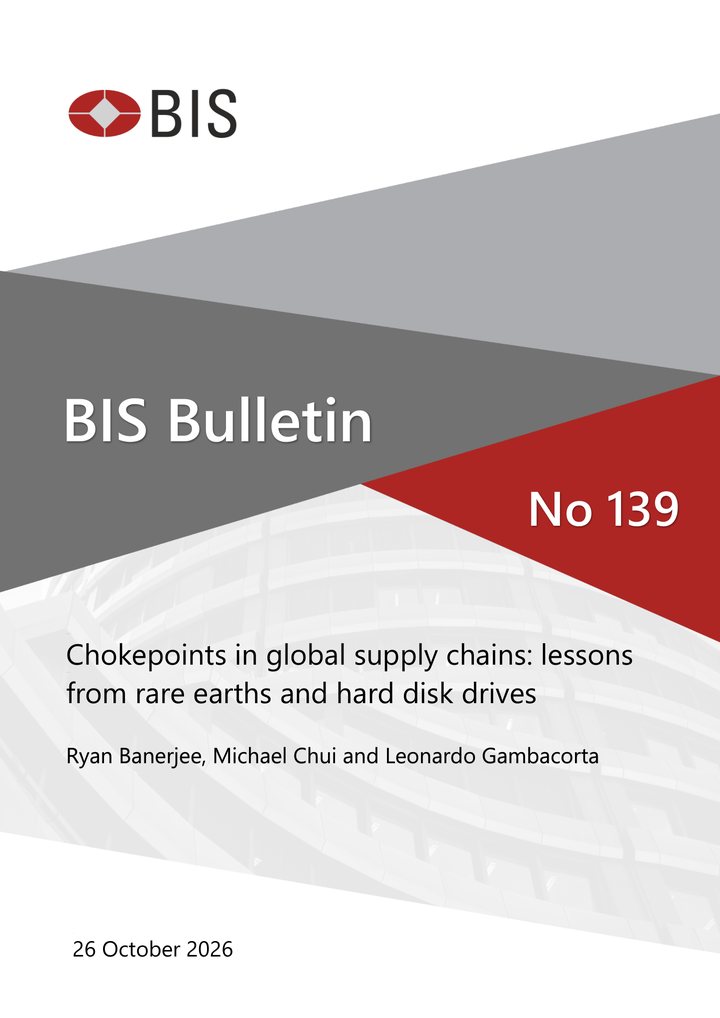
Chokepoints in global supply chains: lessons from rare earths and hard disk drives (BIS Bulletin No 139)
The BIS distinguishes between persistent dependencies, such as rare earths, and temporary shocks, such as the 2011 Thailand floods, and proposes different resilience measures for each.
- Organization
- Bank for International Settlements (BIS)
- Document date
- 26 October 2026
- Type
- Technical note
- Language
- English
- Scope
- International
- Length
- 8 pages
What it contains
BIS Bulletin 139, by Ryan Banerjee, Michael Chui and Leonardo Gambacorta, starts from the fact that global supply chains delivered large efficiency gains, but complexity and specialization create vulnerabilities: when critical inputs are concentrated among a few firms or countries and cannot be replaced, a disruption in a small part can affect production more widely. Those vulnerabilities become chokepoints whose consequences depend on four factors: whether the buyer can substitute the supplier or the input, whether the disruption is temporary or persistent, whether inventories or other buffers exist and whether firms can shift production, redesign products or develop new suppliers.
The first case is rare earths and other critical minerals, a structural chokepoint: the vulnerability is not physical scarcity but the concentration of processing capacity. China held about 60% of global reserves in 2025 and around 90% of global capacity in separation, metal refining and manufacturing of neodymium-iron-boron magnets; trade restrictions can create persistent supply risks, as shown by the halt of gallium exports from May 2025 and the divergence of its prices outside China. The second case is hard disk drives: Thailand produced about 40% of the world’s hard disk drives in 2011 and the floods cut its output 55% year on year in the fourth quarter; Western Digital’s Thai factories went from 52.2 to 28.5 million units shipped, but restarted within 46 days.
The conclusion is that measures must match the vulnerability. For persistent dependencies, alternative capacity and technologies help; for temporary disruptions, inventories, supplier redundancy and geographical flexibility, together with effective crisis management to speed up recovery.
Why it matters for risk management
It is useful for analyzing supplier concentration, business continuity and third-party risk in real-sector companies (manufacturing, free trade zones, tourism, construction and commerce) and for the banks and insurers that finance or insure those chains. The evidence comes from two specific industries and does not measure the Dominican Republic’s exposure; applying it to each company requires mapping its own critical inputs and suppliers.
Summary prepared by the Dominican Republic Risk Management Club from a reading of the original document, with the source verified on 15 November 2026. It does not replace reading the official text and is not advice.



Connect with our networks