

Study · International body
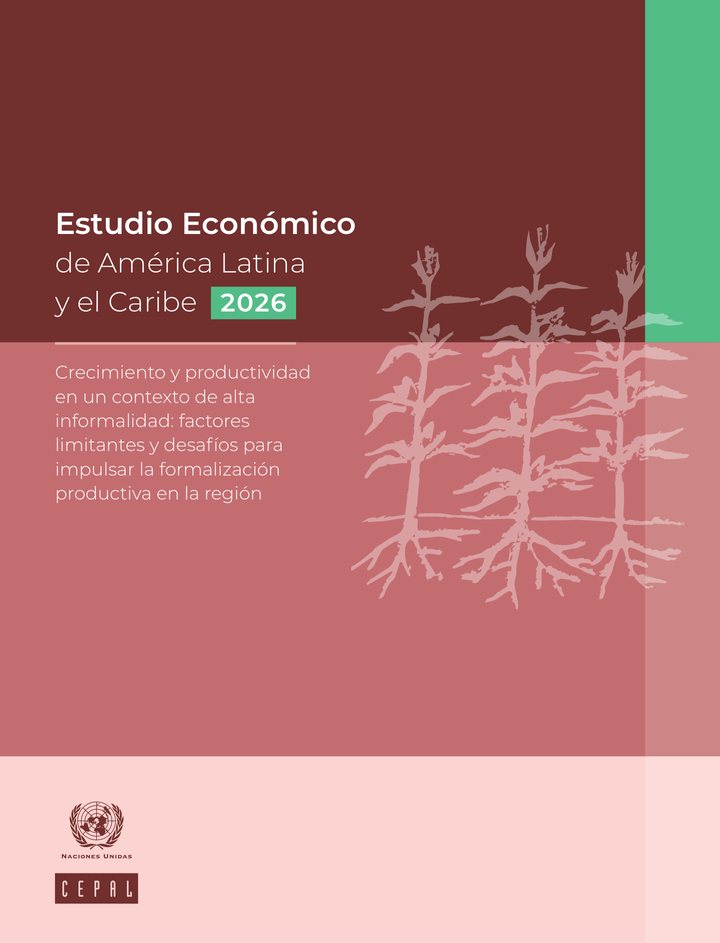
Economic Survey of Latin America and the Caribbean 2026: Growth and productivity amid high informality
ECLAC warns that the region’s low growth is structural, with low investment, little productivity and high informality, and that the 2026 external environment aggravates it.
- Organization
- Economic Commission for Latin America and the Caribbean (ECLAC)
- Document date
- 20 August 2026
- Type
- Study
- Language
- Spanish
- Scope
- Latin America and the Caribbean
- Length
- 203 pages
What it contains
The 78th edition of the Economic Survey of Latin America and the Caribbean combines a regional macroeconomic report with 2026 and 2027 outlooks and an analysis of growth and productivity in a context of high informality. In 2025 the region grew 2.4 % in an environment of uncertainty, protectionism and volatility; inflation kept converging toward targets, employment grew about 1.6 % (some 4.3 million jobs), unemployment fell to 5.3 % and labor informality, although it declined, remains close to 50 % of the employed. The current account deficit was 1.2 % of GDP, with net capital inflows of 2.2 % of GDP that relied on short-term factors.
For 2026 and 2027, ECLAC projects regional growth of 2.2 % and 2.5 %, a pace that is not enough to raise income per capita in a sustained way or close development gaps. The hostilities that began in the Islamic Republic of Iran in late February 2026 disrupted the world oil supply, raised energy volatility and would bring world growth down to 2.9 %, the lowest since 2022. Gross public debt is around 52 % of GDP in Latin America and 73 % in the Caribbean. The survey points to the global boom in private credit as an emerging risk for financial stability, even though the region’s direct exposure is marginal, and recommends the active use of prudential policy tools. For the Dominican Republic it projects growth of 2.1 % in 2025, 4.0 % in 2026 and 4.4 % in 2027.
The second part argues that informality is not only a labor market problem: it also holds back productive transformation. With an analysis inspired by the Kaldor-Verdoorn law, the survey shows that growth raises productivity in both the formal and the informal sector, but with more intense, faster and longer-lasting effects in the formal one, because of its greater capacity for scale, innovation and financing. It proposes productive formalization strategies that go beyond regulatory reforms or tax incentives, combining labor, fiscal, financial and productive development policies, together with investment, technology adoption and regional integration.
Why it matters for risk management
It offers the macroeconomic and structural context in which the region’s companies and financial institutions operate: growth, employment, debt, financing conditions and informality. It helps build scenarios of strategic risk, sector credit risk and capital planning with a regional source. ECLAC’s projections are one reference among several and are revised; the survey does not assess individual institutions and does not replace the Central Bank’s data.
Resumen elaborado por el Club de Gestión de Riesgos de la República Dominicana a partir de la lectura del documento original, con fuente verificada el 18 de octubre de 2026. No sustituye la lectura del texto oficial ni constituye asesoría.


Connect with our networks