

Research · Local regulator and supervisor
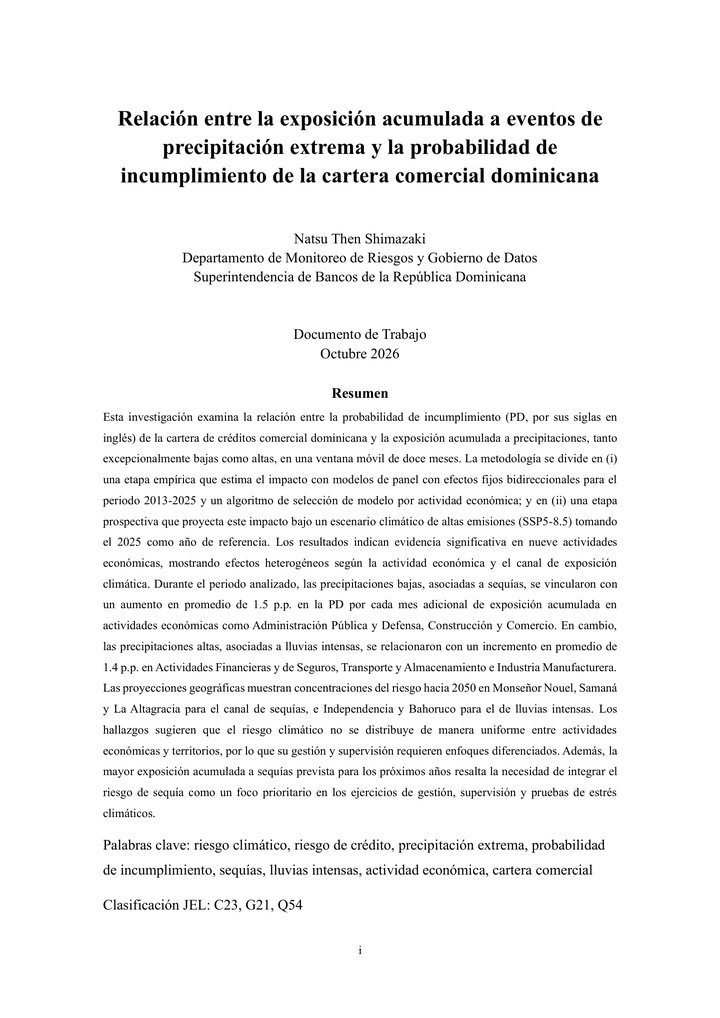
Relationship between cumulative exposure to extreme precipitation events and the probability of default of the Dominican commercial portfolio
Drought and intense rainfall do not hit every sector or every province alike: the effect on the probability of default depends on the economic activity and the channel.
- Organization
- Superintendency of Banks of the Dominican Republic (SB)
- Document date
- 7 October 2026
- Type
- Research
- Language
- Spanish
- Scope
- Dominican Republic
- Length
- 68 pages
- Authorship
- Natsu Then Shimazaki
What it contains
The working paper, published by the Superintendency of Banks in October 2026 and signed by Natsu Then Shimazaki, of the Risk Monitoring and Data Governance Department, studies how the probability of default (PD) of the commercial portfolio relates to cumulative exposure to exceptionally low or high precipitation over a rolling twelve-month window. The empirical stage uses a panel of PD by economic activity, province and month between November 2013 and December 2025, with two-way fixed effects models and a model selection algorithm by activity. The forward-looking stage projects the impact to 2050 under the high-emissions scenario SSP5-8.5, with 2025 as the reference year.
Models were estimated for 17 economic activities and there is significant evidence in nine. With low precipitation, associated with droughts, historical PD rose in Public Administration and Defense (2.4 percentage points), Construction (1.9) and Trade (0.2), and Fishing showed a negative effect (-1.8). With high precipitation, associated with intense rainfall, it rose in Financial and Insurance Activities (2.4), Transport and Storage (1.2) and Manufacturing (0.6). Agriculture (-0.8) and Electricity (-2.5) showed negative associations that the study cautiously attributes to factors it does not control, such as reserve requirement releases after climate events. The rainfall thresholds that matter also differ from one activity to another.
Under SSP5-8.5, exposure to droughts would increase by 0.6 events per month on average between 2026 and 2050 relative to 2025, which raises the aggregate PD of the sensitive activities by about 0.3 percentage points, while exposure to intense rainfall would fall. The aggregate impact is moderate but concentrated by territory: for drought, in Monseñor Nouel, Samaná and La Altagracia; for rainfall, in Independencia and Bahoruco. The paper states its limits: a panel that is short in climate terms, an identification assumption that relief measures could bias, sensitivities assumed to be constant, and an exercise that isolates only climate and is limited to precipitation, without temperature. It also clarifies that the opinions are the author’s and not necessarily those of the Superintendency.
Why it matters for risk management
It is a local input, with data from the Dominican commercial portfolio, for incorporating physical climate risk into credit assessment, the analysis of concentrations by sector and province and stress tests. The interpretations of the transmission mechanisms are exploratory and not causal evidence, and the opinions are the author’s, not necessarily the Superintendency’s. It is best read as a first quantitative basis and not as a full projection of PD.
Resumen elaborado por el Club de Gestión de Riesgos de la República Dominicana a partir de la lectura del documento original, con fuente verificada el 15 de octubre de 2026. No sustituye la lectura del texto oficial ni constituye asesoría.








Connect with our networks