

Research · International body
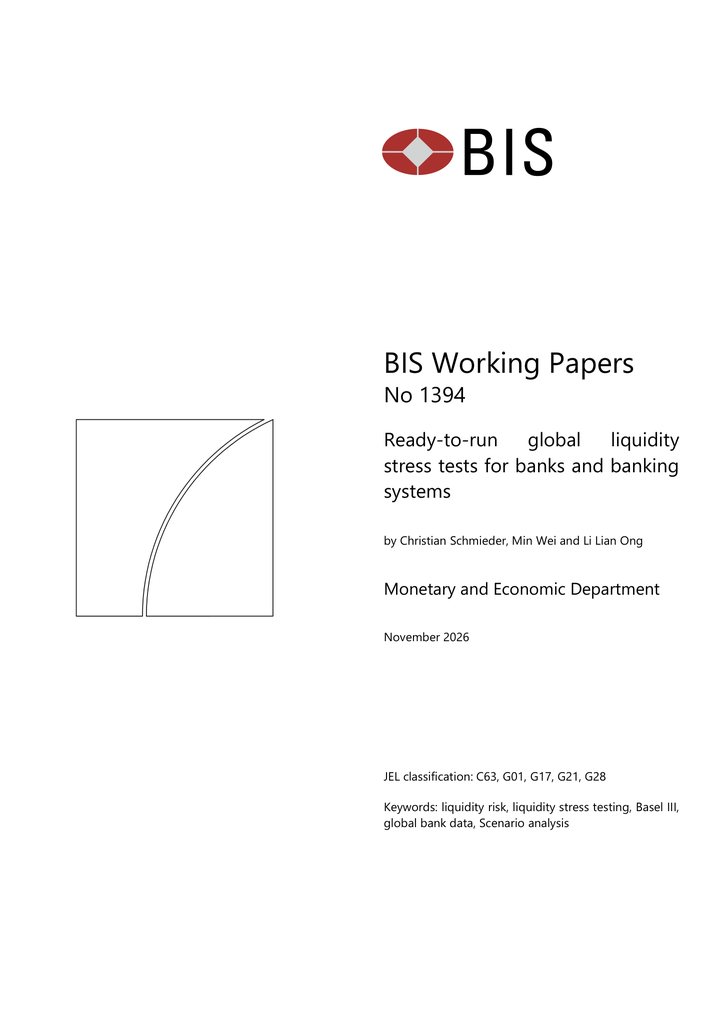
Ready-to-run global liquidity stress tests for banks and banking systems
An open tool measures how much liquidity stress a bank or banking system can withstand, and shows that resilience has improved since Basel III but remains heterogeneous and persistent across countries.
- Organization
- Bank for International Settlements (BIS)
- Document date
- 11 November 2026
- Type
- Research
- Language
- English
- Scope
- International
- Length
- 48 pages
- Authorship
- Christian Schmieder, Min Wei and Li Lian Ong
What it contains
BIS Working Paper No 1394, by Christian Schmieder, Min Wei and Li Lian Ong, starts from the fact that public information on banks’ liquidity resilience is scarce: regulatory disclosures have limited coverage and history, and supervisory stress tests use confidential data. To fill that gap it presents an interactive, freely available toolkit hosted by AMRO that applies shocks in the style of the Basel III liquidity coverage ratio (LCR) to nearly 13,000 commercial banks in more than 100 economies since 2006, with pre-calibrated benchmark scenarios, pre-run simulations and user-defined scenarios.
The central metric is the “breakeven stress factor”: the minimum shock intensity at which a bank’s net liquidity turns negative. Using the toolkit, the authors find that liquidity buffers have improved since Basel III, but with significant differences across and within countries, and that the relative ranking of banking systems is persistent over time. The experience of the banks that failed in 2023 shows that annual structural metrics can look reassuring shortly before a crisis, so they should be complemented with higher-frequency data and sensitivity analysis.
The paper warns that deposit run-off rates rise in a digitalised world and that the growth of non-bank financial institutions and their links with banks challenge existing frameworks, so the next generation of liquidity stress tests should span the whole financial system and not only commercial banks.
Why it matters for risk management
It gives liquidity risk, treasury and supervision teams a reproducible way to compare the liquidity resilience of banks and systems with public data and to run their own sensitivity tests, and it shows the limits of annual structural indicators. It is a working paper: it expresses the authors’ views and does not analyze the Dominican banking system.
Resumen elaborado por el Club de Gestión de Riesgos de la República Dominicana a partir de la lectura del documento original, con fuente verificada el 24 de noviembre de 2026. No sustituye la lectura del texto oficial ni constituye asesoría.




Connect with our networks