

Report · International body
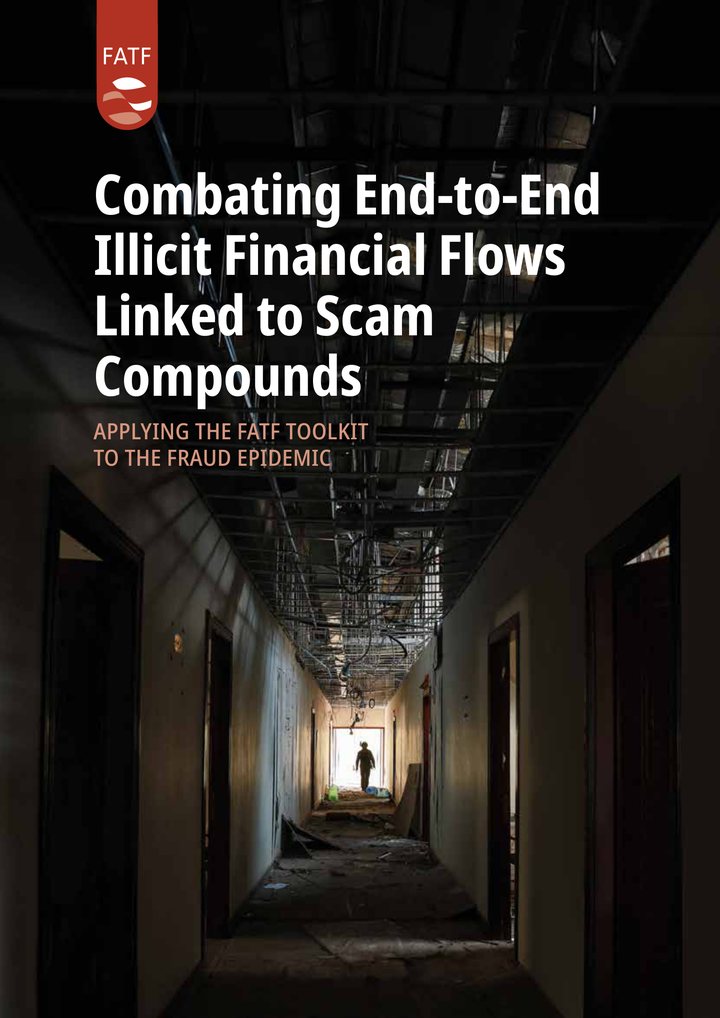
Combating End-to-End Illicit Financial Flows Linked to Scam Compounds: Applying the FATF Toolkit to the Fraud Epidemic
The FATF estimates that fraud costs about $500 billion a year worldwide and that scam compounds, with losses in the tens of billions, have expanded since 2020; it proposes disrupting their financial flows end to end and acting within the first 24 to 72 hours.
- Organization
- Financial Action Task Force (FATF)
- Document date
- 5 November 2026
- Type
- Report
- Language
- English
- Scope
- International
- Length
- 90 pages
What it contains
The FATF report, published on 5 November 2026 and co-led by the United Kingdom and the United States, starts from the premise that fraud is among the main predicate offences for money laundering and costs about $500 billion a year worldwide, according to an estimate by the Global Anti-Scam Alliance that the document cites. Scam compounds, an industrial-scale model that expanded rapidly from around 2020, are nodes of transnational criminal ecosystems where cyber-enabled fraud converges with human trafficking, corruption, cybercrime and money laundering. Their annual losses are estimated in the tens of billions of dollars and their hubs have targeted people in more than 100 jurisdictions. The work drew on a questionnaire to the FATF Global Network, with inputs from 60 jurisdictions, and on consultations with the private sector, civil society and academic experts.
The financial model is circular and modular: the networks spend to set up physical and digital infrastructure and to acquire workers and victims, generate revenue, collect, move, layer and cash out the money, and reinvest the profits. Funds can pass through accounts and virtual asset wallets within minutes, in some reported cases within two minutes, faster than the victim’s report, the filing of suspicious transaction reports and law enforcement action. Because it is often the victim who authorizes the payment, the transaction can look legitimate to the financial institution unless it is combined with fraud signals the institution does not usually receive. The report adds that operations are dispersing into smaller, mobile structures and that artificial intelligence, deepfakes and multilingual content make it easier to acquire victims.
In response, it combines direct action against the networks with improvements to the anti-fraud system: anti-scam centres, shared fraud data, collaborative analytics and rapid response mechanisms, many through public-private partnerships. Intervening on payments falls mainly to the financial institution or virtual asset service provider that controls the account or wallet, supported by financial intelligence units and authorities; after detection or a report, the first 24 to 72 hours are key for tracing, recovery and restitution. Its six principles (Annex 1) are: target the wider criminal ecosystem, disrupt illicit financial flows end to end, connect the networks, act at speed across borders, put victims at the centre, and adapt while focusing on lasting impact. It warns that success should not be measured by the number of alerts, arrests or freezes, but by whether victims are protected and the criminal business is sustainably degraded.
Why it matters for risk management
It is a reference for the anti-money-laundering, fraud and operational-risk teams of banks, payment institutions and insurers, and for the security areas of companies that receive digital payments: it guides early alerts, cross-sector co-operation and fast response. According to the report itself, its application should be risk-based for each jurisdiction, and the cases mainly describe compounds in other regions, so its use in the Dominican Republic requires a local risk analysis.
Summary prepared by the Dominican Republic Risk Management Club from a reading of the original document, with the source verified on 16 November 2026. It does not replace reading the official text and is not advice.



Connect with our networks