


Technical note · International body
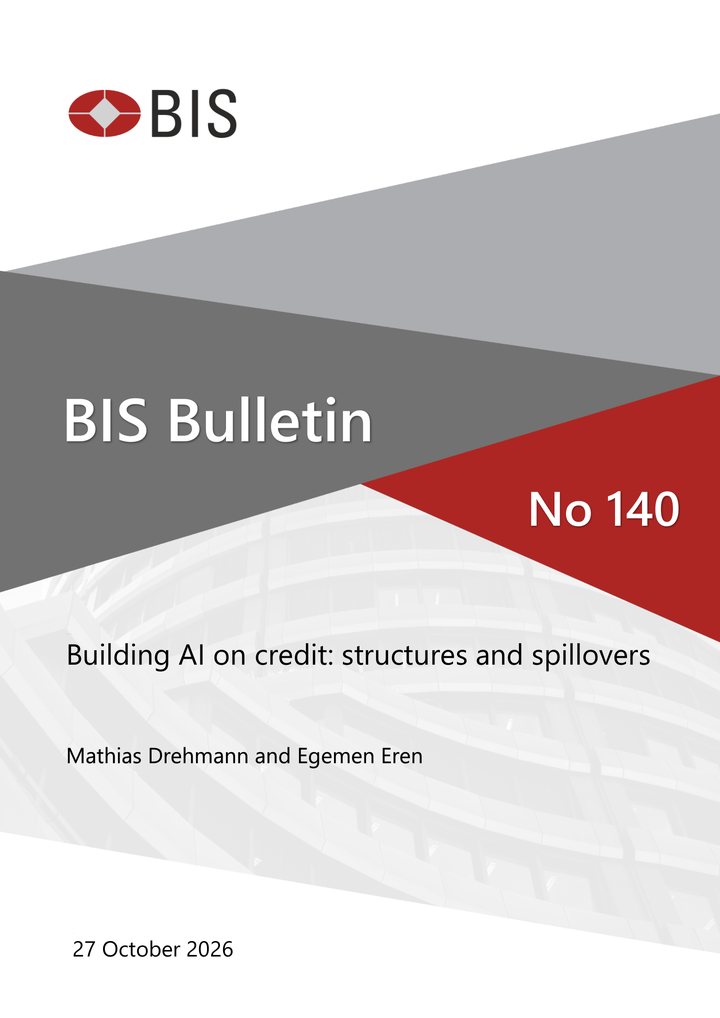
Building AI on credit: structures and spillovers (BIS Bulletin No 140)
The BIS warns that the credit behind AI investment is spread across off-balance sheet structures that hide who bears the losses, and that its effect on bond markets is small today but could grow.
- Organization
- Bank for International Settlements (BIS)
- Document date
- 27 October 2026
- Type
- Technical note
- Language
- English
- Scope
- International
- Length
- 8 pages
What it contains
BIS Bulletin 140, by Mathias Drehmann and Egemen Eren, studies how the build-out of artificial intelligence infrastructure is financed with debt. Capital expenditure by the five largest US cloud providers would exceed $800 billion by the end of 2026, around 2.5% of US GDP, and their gross bond issuance reached $222 billion in September, mostly at long maturities, equal to more than 10% of long-term Treasury issuance for the year. In addition, according to market sources, between $75 billion and $100 billion of bonds and asset-backed securities linked to off-balance sheet vehicles were placed in 2026, and Moody’s puts data centre lease commitments at $1.2 trillion by mid-2026, of which about $820 billion have not yet started.
The first question is who bears the losses if returns fall short. Off-balance sheet vehicles draw in institutional capital by combining asset backing with lease commitments, guarantees and vendor backstops, but those structures obscure the final allocation of risk, and exposures are concentrated in a few large firms more than their balance sheets suggest. Banks often lend both to the vehicles and to the investors that hold the debt. The second question is whether there are broader effects: much of the debt is long term and is held by non-bank financial institutions that also hold government and investment-grade corporate bonds.
On 18 days in 2026 with AI-financing news, the 10-year Treasury term premium rose by around 1.5 basis points on average after adjusting for other factors, and investment-grade spreads moved little and briefly. The bulletin concludes that so far the effects have been limited, but that sustained issuance at the current pace could make them larger and more persistent.
Why it matters for risk management
It helps look at the concentration, counterparty and contagion risk that complex financing and off-balance sheet exposures bring, which is also useful for analyzing infrastructure projects, leases and guarantee structures in the region. It is an analysis of US markets; it does not cover the Dominican Republic, and its market figures are estimates from private sources cited by the BIS.
Summary prepared by the Dominican Republic Risk Management Club from a reading of the original document, with the source verified on 15 November 2026. It does not replace reading the official text and is not advice.




Connect with our networks