


Survey · Consulting firm
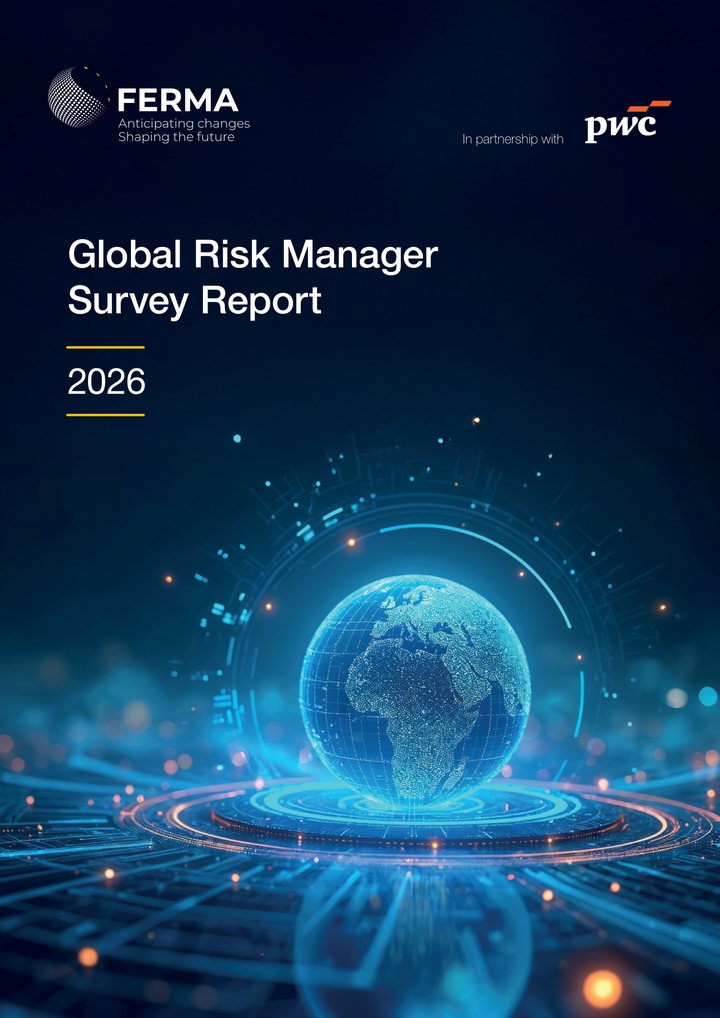
Global Risk Manager Survey Report 2026
Risk managers in organizations of every sector put geopolitical uncertainty and cyberattacks first at 12 months, and artificial intelligence first at three years.
- Organization
- Federation of European Risk Management Associations (FERMA) and PwC
- Document date
- October 2026
- Type
- Survey
- Language
- English
- Scope
- International
- Length
- 38 pages
What it contains
The FERMA and PwC survey has been published every two years since 2002 and has been global since 2024. The 2026 edition gathers 1,329 responses from 79 countries collected between January and April 2026; 78% of participants are European, so the report separates differences in other regions into inserts. 39% belong to industrial companies, 28% to financial services, 23% to services and 10% to the public sector, and three profiles are distinguished: enterprise risk management, insurance management and mixed profiles.
At 12 months, the top five risks are geopolitical uncertainty, cyberattacks, uncertain economic growth, AI use and regulation. At three years, AI use moves to first place, followed by geopolitical uncertainty, cyberattacks, failure to innovate or respond to disruption, and regulation. 92% of risk managers are involved in corporate strategy in some way and about two thirds take part in global and strategic risk maps; the priorities are strategic risk response (55%) and operational resilience (53%). AI appears both as a threat and as a risk management tool.
The report also reviews the integration of climate change into risk maps (61%), the uneven progress of ESG topics, the use of technology in risk management (81% still use spreadsheets and presentations) and insurance strategies: 56% keep risk retention as the main strategy, 27% use a captive and 51% do not believe that some risks will become uninsurable. It closes with an enterprise risk management maturity model.
Why it matters for risk management
It offers a comparison point for the risk teams of real-sector, services and public-sector organizations, not only banks: which risks their peers prioritize, how they take part in strategy and how they use technology and insurance. The sample is mostly European and from large organizations, and the survey collects declared perceptions and practices, so its results cannot simply be extrapolated to companies in the Dominican Republic.
Summary prepared by the Dominican Republic Risk Management Club from a reading of the original document, with the source verified on 15 November 2026. It does not replace reading the official text and is not advice.


Connect with our networks