

Research · Risk Management Club
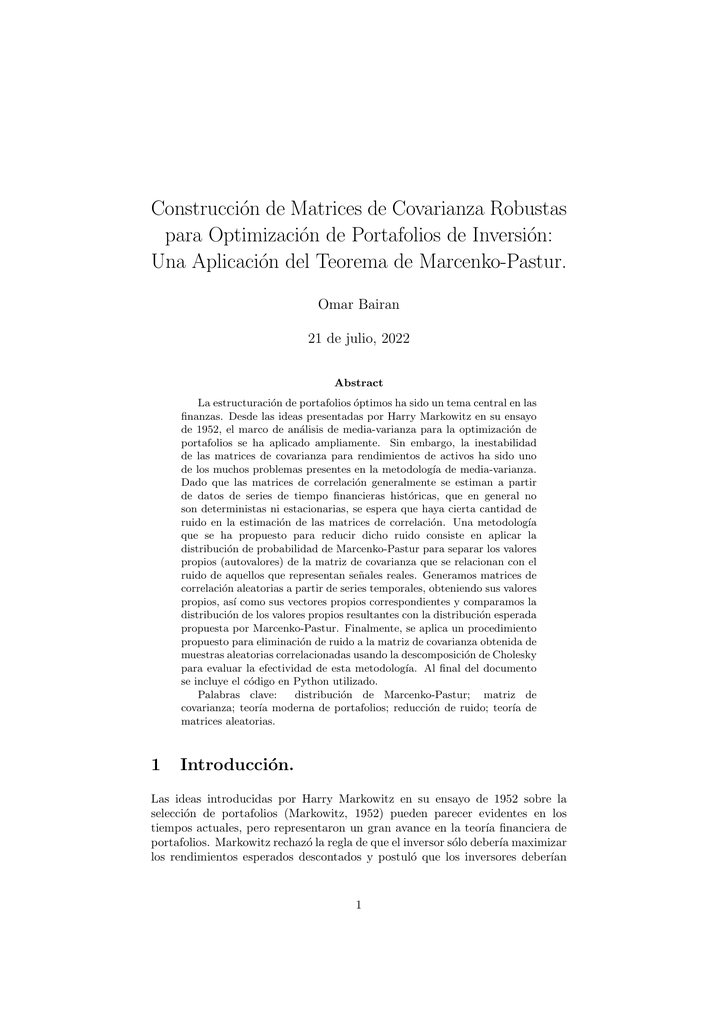
Construction of Robust Covariance Matrices for Investment Portfolio Optimization: An Application of the Marcenko-Pastur Theorem
Covariance matrices estimated from historical data contain noise; random matrix theory makes it possible to separate it from the signal.
- Organization
- Dominican Republic Risk Management Club (CGR)
- Document date
- 21 July 2022
- Type
- Research
- Language
- Spanish
- Scope
- Dominican Republic
- Length
- 14 pages
- Authorship
- Omar Bairan
What it contains
The work starts from a classic problem of modern portfolio theory: Markowitz’s mean-variance framework suffers from the instability of covariance matrices, which are estimated from financial time series that are neither deterministic nor stationary and therefore include noise. It proposes applying the Marcenko-Pastur probability distribution to separate the eigenvalues of the covariance matrix that correspond to noise from those that represent real signals.
The methodology generates random correlation matrices from time series, obtains their eigenvalues and eigenvectors and compares the resulting distribution with the expected Marcenko-Pastur one. It then applies a denoising procedure to the covariance matrix obtained from correlated random samples, using the Cholesky decomposition, and compares the minimum variance of three portfolios: one built with the true matrix, one with the matrix estimated from samples and one with the denoised matrix.
According to its conclusion, with the denoised matrix a considerable reduction in the portfolio’s standard deviation is achieved, of more than 22 % relative to the portfolio built with the correlation matrix obtained from observed data. The data are simulated and the portfolio is synthetic, and the document includes at the end the Python code used.
Why it matters for risk management
It is a technical reference for market risk and investment teams interested in the stability of covariance matrices. Because the data are simulated, the results illustrate the method and require validation with real data before they are used in investment decisions.
Research published by the Club in its research library. No version on another site was found; the PDF hosted here is linked.
Summary prepared by the Dominican Republic Risk Management Club from a reading of the original document, with the source verified on 7 October 2026. It does not replace reading the official text and is not advice.









Connect with our networks