

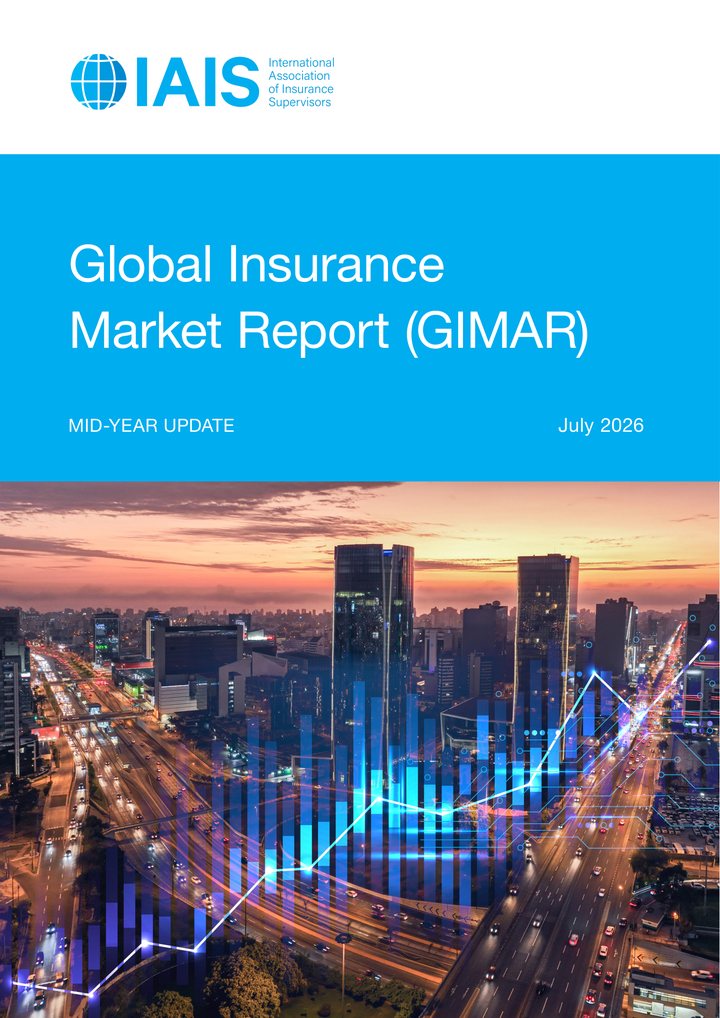
Report · International body
Global Insurance Market Report (GIMAR): mid-year update, July 2026
The global insurance sector closed 2025 with stable solvency, liquidity and profitability, but the IAIS is already watching sovereign yields, geopolitical risk and AI-enabled cyber attacks.
- Organization
- International Association of Insurance Supervisors (IAIS)
- Document date
- July 2026
- Type
- Report
- Language
- English
- Scope
- International
- Length
- 18 pages
What it contains
The mid-year update of the Global Insurance Market Report (GIMAR) presents the preliminary results of the 2026 Global Monitoring Exercise (GME) of the International Association of Insurance Supervisors (IAIS), ahead of the year-end report scheduled for December. It uses data collected up to June 2026 with year-end 2025 as the reference date: individual monitoring of 56 of the largest international insurance groups from 18 jurisdictions, and qualitative sector-wide monitoring covering more than 90 % of global gross written premiums. The charts and results may change in the final edition.
The 2025 diagnosis is one of stability. The aggregate solvency ratio declined slightly but stayed well above regulatory requirements, because of interest rate volatility, adverse market movements, and share buybacks, dividends, debt redemptions and mergers. Liquidity remained stable and return on assets increased, with better underwriting margins and greater diversification. The aggregate systemic risk scores of insurance groups rose slightly, with the largest increases in asset liquidation and interconnectedness. The 2026 macro-financial environment is more uncertain: the IMF projects global growth of 3.0 % in 2026 and inflation of 4.7 %.
The 2026 exercise has three themes. First, the impact of macroeconomic risks on life insurers’ balance sheets: market and investment risks, liquidity pressures, sovereign risk, interconnectedness with non-bank financial intermediaries, and capital and asset-liability management, with private credit as a focus (the FSB estimates it at about US$2.0 trillion globally at the end of 2024). Second, the channels through which geopolitical risk reaches non-life insurance: inflation and claims costs, maritime and aviation risks, and the difficulty of applying war exclusions to cyber operations. Third, the impact of artificial intelligence and technology on insurers’ cyber resilience. AI underwriting, digital assets and climate-related risks are added.
Why it matters for risk management
It is a reference reading on how regulators supervise insurance risk and what they are watching in 2026: investments, liquidity, private credit, catastrophes and cybersecurity. For insurers, reinsurers, brokers and companies that buy insurance, it helps compare stress scenarios and capital and asset-liability management. The data come from international groups and IAIS jurisdictions; they do not describe the Dominican market, and the preliminary figures may change in the December edition.
Resumen elaborado por el Club de Gestión de Riesgos de la República Dominicana a partir de la lectura del documento original, con fuente verificada el 18 de octubre de 2026. No sustituye la lectura del texto oficial ni constituye asesoría.

Connect with our networks