


Report · International body
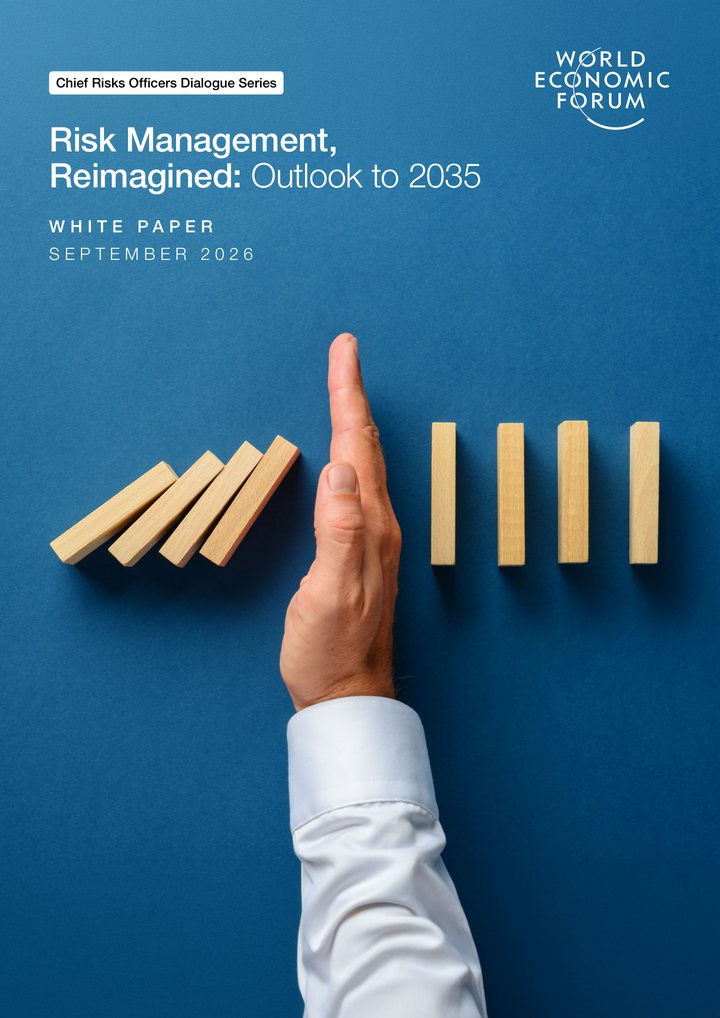
Risk Management, Reimagined: Outlook to 2035
Only 10% of chief risk officers consider themselves very prepared for risks that cannot be modelled with historical data, and 80% expect risk management to be more difficult in 2035.
- Organization
- World Economic Forum (WEF)
- Document date
- 18 September 2026
- Type
- Report
- Language
- English
- Scope
- International
- Length
- 23 pages
What it contains
The September 2026 white paper gathers consultations with chief risk officers (CROs) from several sectors and a survey of the Forum’s CRO community. It starts from the view that traditional integrated risk management frameworks, built to identify threats, estimate their likelihood and impact and apply controls, remain useful but rely heavily on historical data and periodic reviews, while geoeconomic fragmentation, technological disruption, cyber insecurity, climate volatility and societal polarization interact more strongly and faster. 10% of the CROs surveyed say they are very prepared for risks that cannot be modelled with historical data and 80% believe risk management will be somewhat or far more challenging in 2035.
It identifies four shifts: moving from prediction to preparedness, with the governance, capabilities and decision processes to respond; from compliance to strategic enablement, with the CRO taking part in the early stages of decisions; from periodic reviews to continuous monitoring and risk intelligence; and the integration of AI with human intelligence, where AI handles monitoring, aggregation, anomaly detection and simulation, and people handle interpretation, judgement and accountability. It also stresses that risks are increasingly interconnected and that it is worth understanding their interdependencies, not just each category separately.
To build a risk-ready organization it proposes concrete capabilities: continuous sensing and early warning, scenario planning and digital twins that simulate several threats at once, incorporating regional nuances and balancing AI with human judgement. It concludes that the CRO of the future will be less a risk controller and more an interpreter of uncertainty, and that success will be measured by how much the function improves strategic decisions and resilience, not only by compliance or the absence of losses.
Why it matters for risk management
It is a reference for those building or reviewing integrated risk management frameworks in banks, insurers, real-sector companies and public entities, and for preparing conversations with boards and committees: risk appetite, scenarios that combine several risks, reporting frequency and the use of AI. It is based on consultations and a survey of CROs from large organizations and several regions, and it is a perspective document, not a rule or a mandatory methodology.
Summary prepared by the Dominican Republic Risk Management Club from a reading of the original document, with the source verified on 15 November 2026. It does not replace reading the official text and is not advice.


Connect with our networks