

Report · International body
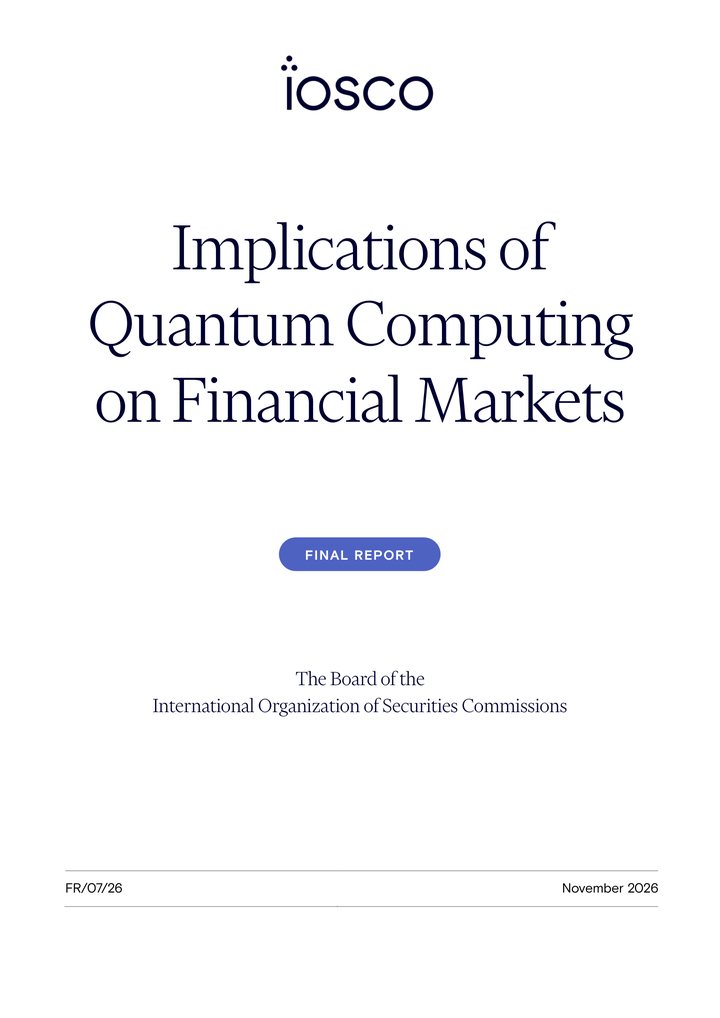
Implications of Quantum Computing on Financial Markets
Quantum computing does not yet operate in regulated financial services, but IOSCO warns that migrating to post-quantum cryptography and achieving crypto-agility requires starting now.
- Organization
- International Organization of Securities Commissions (IOSCO)
- Document date
- 19 November 2026
- Type
- Report
- Language
- English
- Scope
- International
- Length
- 63 pages
What it contains
IOSCO’s final report, published on 19 November 2026, analyzes four areas: the possible applications of quantum computing in markets, the vulnerabilities of cryptographic systems and blockchains, jurisdictions’ measures for preparedness and the transition to post-quantum cryptography (PQC), and the state of that preparedness among authorities and regulated firms. It draws on a survey of IOSCO members, consultations with experts and market participants and a review of the literature.
Applications are at an early stage: possible uses are concentrated in portfolio optimization, simulation and modelling, machine learning, derivatives pricing, risk management, fraud detection and market surveillance, and no surveyed jurisdiction reported operational deployment in regulated financial services. The report warns of the risk of “quantum washing”, that is, overstating the maturity of these uses. The broadest threat is that a sufficiently capable quantum computer could weaken the public-key algorithms that support secure communications, digital signatures and authentication, with risk for institutions, market infrastructures and blockchains, including the “harvest now, decrypt later” scenario.
IOSCO identifies migration to PQC and crypto-agility as the central components of preparedness. Jurisdictions converge on discovering and inventorying cryptography, planning the transition, testing and coordinating with third parties, but the sector’s preparedness remains at an early stage: it is concentrated on awareness, governance and preliminary plans, with third-party dependencies, a shortage of specialists and resources as the main challenges and some “quantum procrastination”.
Why it matters for risk management
For financial institutions, exchanges, central depositories and technology providers in the region, it is a guide to what to do about quantum risk before it becomes urgent: inventory the cryptography in use, plan the migration and coordinate with providers. It serves technology risk, cybersecurity, third-party risk and continuity. It is an international report by securities regulators: it is not a rule and does not assess the Dominican market.
Resumen elaborado por el Club de Gestión de Riesgos de la República Dominicana a partir de la lectura del documento original, con fuente verificada el 24 de noviembre de 2026. No sustituye la lectura del texto oficial ni constituye asesoría.

Connect with our networks