

Report · Supervisor
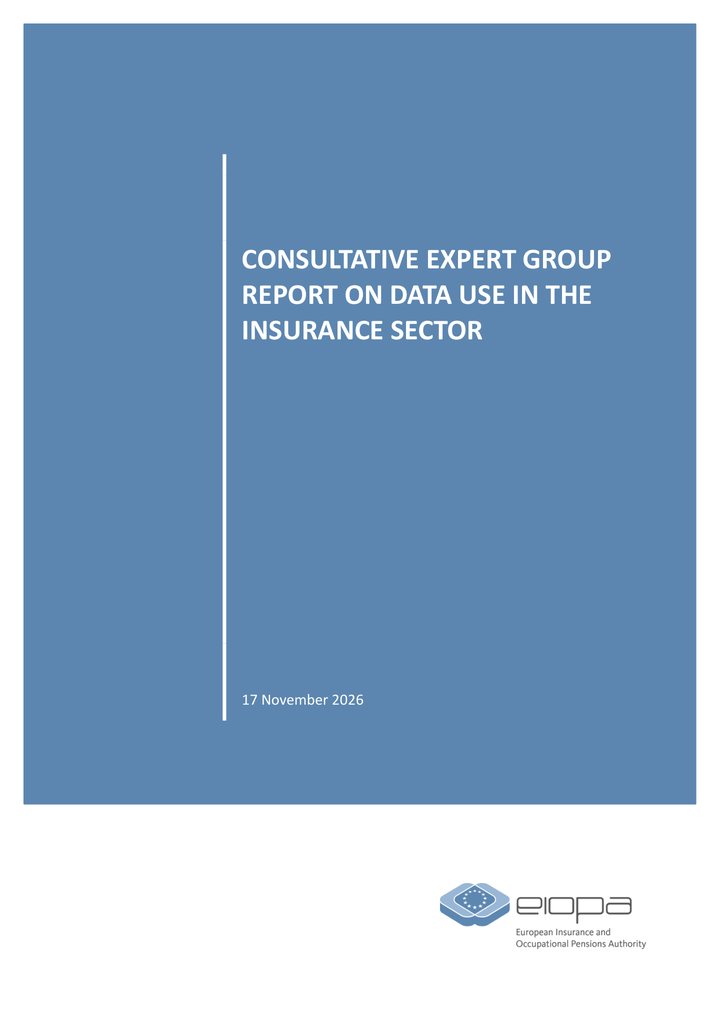
CEG Report on the Use of Data in the Insurance Sector
EIOPA proposes a proportionate, outcomes-focused approach: neither maximizing nor minimizing data use, but achieving better outcomes for consumers without compromising trust, fairness or financial resilience.
- Organization
- Autoridad Europea de Seguros y Pensiones de Jubilación (EIOPA)
- Document date
- 24 November 2026
- Type
- Report
- Language
- English
- Scope
- European Union
- Length
- 54 pages
What it contains
The report, published on 24 November 2026, presents the work of EIOPA’s consultative expert group on data use in insurance, made up of specialists from insurers, reinsurers, pensions, associations, academia, consumer organizations, civil society and consultancies. It starts from the fact that traditional data, such as demographic, claims and exposure data, are increasingly complemented by telematics, connected devices, digital interactions and environmental and climate data. It focuses on data use rather than on the risks specific to artificial intelligence, although it considers AI where it amplifies benefits or risks.
It examines the tensions between solidarity, personalization, inclusion, fairness, autonomy, privacy, security and discrimination, and compares them in two stylized scenarios of limited and extensive data use, which are not forecasts. With less data there is less exposure to privacy, cybersecurity and governance risks, but there may be blind spots, more adverse selection and lower insurability; with more data, risk assessment and prevention improve, but privacy, cybersecurity, model, governance and third-party risks grow, and affordability or access may be affected for higher-risk or data-poor consumers.
The report identifies five principles: access to insurance, fair and affordable outcomes, integrity, transparency and meaningful choice, prudential soundness and safe progress. For supervisors it proposes a proportionate, outcomes-oriented approach within existing frameworks: monitoring exclusion and affordability, challenging insurers’ data-use impact assessments, addressing explainability, bias, validation, human oversight and consumer redress, and monitoring reliance on data providers, AI systems and digital ecosystems.
Why it matters for risk management
It addresses the use of data and analytical models in insurance from the standpoint of market conduct and prudential risk, a topic increasingly present among insurers, brokers and technology firms in the region. It serves model risk, third-party risk, data governance, conduct and compliance. It is a report of a European consultative group: it proposes principles and is not a rule, and it does not measure the Dominican insurance market or reflect its regulation.
Resumen elaborado por el Club de Gestión de Riesgos de la República Dominicana a partir de la lectura del documento original, con fuente verificada el 24 de noviembre de 2026. No sustituye la lectura del texto oficial ni constituye asesoría.




Connect with our networks